
Search Tennessee Inmate Records
Tennessee correctional institutions comprise state prisons, county jails, rehabilitation centers, private prisons, and specialized treatment programs. Tennessee is also home to several federal correctional facilities designed for persons facing federal convictions. Presently, the Tennessee correctional system consists of 14 state prisons, 95 county jails, and 4 contract and privately managed prisons. There are also 2 federal correctional institutions in the state.
Among the 14 state prisons in Tennessee are 3 female detention centers. These centers house female offenders providing them with gender-specific programs and care. Likewise, Tennessee has a Youth Development Center that serves minors between the ages of 13 to 18 committed to state custody for various juvenile offenses.
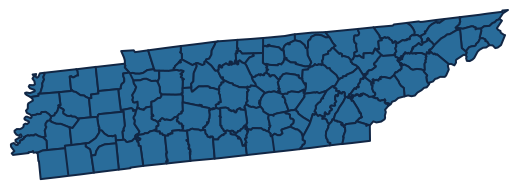

Tennessee prisons provide a secure and rehabilitative environment for inmates. The prison system comprises a range of facilities to accommodate the needs of various inmates across the state. These facilities include:
- State Prisons: The state's correctional facilities accommodate persons convicted of felony crimes serving long sentences, usually above one year.
- Private Prisons: Tennessee has 4 privately managed prisons that work in collaboration with the state prisons. Private prisons provide medium-security incarceration.
- County Jail: County jails provide housing for persons convicted of misdemeanors and lesser felony charges. Typically, county jail confines persons with less than one year sentence and persons awaiting trial.
- Specialized Facilities: Tennessee has several specialized facilities offering medical and mental health care services, rehabilitation programs, substance abuse programs, life skill development, and vocational training to inmates.
Tennessee prisons are structured to accommodate inmates based on their security needs. Therefore, high-risk inmates are remanded in maximum-security institutions, while lower-risk inmates are housed in minimum-security prisons. Furthermore, the state provides specialized facilities to cater to inmates with special needs, including inmates in need of intensive medical care.
Tennessee has an incarceration rate of 817 per 100,000 people. Its rate is significantly higher than the U.S. incarceration rate of 614 per 100,000 persons, meaning Tennessee locks up more people than the country. There are over 57,000 behind bars in various correctional facilities in Tennessee. Nearly 24,000 inmates are remanded in state prisons, while county jails house over 26,000 inmates per annum. Federal correctional stations house up to 7,000 inmates, while Youth and involuntary commitments account for over 450 inmates yearly.

Tennessee Department of Corrections Inmate Search
The Tennessee Department of Corrections (TDOC) oversees the custody and rehabilitation of persons sentenced for various offenses in the state. Headed by a Commissioner appointed by the Governor, the TDOC ensures that all correctional facilities are safe and secure for inmates and correctional staff. It manages the daily operations of state prisons, including maintaining security, providing educational programs, preventing escapes, and offering substance abuse programs.
The TDOC is responsible for maintaining inmate records across state prisons. It provides an offender search tool, Felony Offender Information, on its website to look up information on persons currently incarcerated for felony crimes in the state. It also holds records of inmates previously incarcerated and released from state prisons. Inmate information such as their sentences, location, photo, and current status are accessible for free on the web tool.
Inmate records are accessible on the TDOC website by clicking offender search on the TDOC homepage. This takes users to the Felony Offender information page, which provides information about the search tool. A Search Now button underneath the page takes users to the official search page, where record seekers may input the required information to access the inmate record.

Find Inmate by Name
Users can locate an inmate record from the Felony Offender Information web tool using the inmate's name. The portal requires a first and last name to facilitate the search. Entering partial names in the first and last name fields will return all search results that match the search criteria. For instance, using the name Mat will turn up names for Mattew, Mateo, Matteo, Matias, and Mattias. Additionally, searchers may check the box, if the search name matches the inmate's aliases. Also, where the inmate race is known, searchers may choose the appropriate race from the drop-down menu. Using additional parameters like the inmate race and aliases helps refine the search, ensuring that the specific inmate report is located.

Find Inmate by Number
The Felony Offender Information platform also permits viewing inmate records using the inmate's TDOC ID. The TDOC identification number is an eight-digit number assigned by the Department of Correction. The number is unique to inmates and is used to identify offenders throughout the criminal justice system.
How Many Inmates Are Currently Incarcerated in Tennessee?
Tennessee has an estimated total incarcerated population of ~58,900 people across state prisons, county jails, federal facilities, private prisons, juvenile facilities, and other detention categories.
Counts vary by reporting date and agency, so the figures below should be treated as approximate statewide estimates.
| Facility Type | Population | % of Total | Avg. Daily Cost | Capacity Utilization |
|---|---|---|---|---|
| State Prisons | ~21,000 | 35.7% | ~$95 | ~98% |
| County Jails | ~26,000 | 44.1% | ~$75 | ~82% |
| Federal Facilities | ~5,000 | 8.5% | ~$120 | ~91% |
| Private Prisons | ~4,500 | 7.6% | ~$85 | ~95% |
| Juvenile Facilities | ~600 | 1.0% | ~$350 | ~70% |
| Other / Pre-Trial | ~1,800 | 3.1% | ~$65 | Varies |
| Total | ~58,900 | 100.0% | Varies | ~88% |
State Correctional Facilities in Tennessee
The Tennessee Department of Correction operates roughly 14 major state correctional institutions, supported by contracted facilities and community-based supervision programs.
The system includes prisons, specialty facilities, women’s institutions, medical and aged-care units, transition centers, and work-release or community corrections options.
| Facility Name | Type | Location | Capacity | Population | Security Level |
|---|---|---|---|---|---|
| Riverbend Maximum Security Institution | State Prison | Nashville | ~800 | ~760 | Maximum |
| Debra K. Johnson Rehabilitation Center | Women’s Facility | Nashville | ~1,000 | ~930 | Minimum to Maximum |
| Lois M. DeBerry Special Needs Facility | Medical / Aged Facility | Nashville | ~750 | ~700 | Special Needs / Secure |
| Bledsoe County Correctional Complex | State Prison | Pikeville | ~2,500 | ~2,430 | Minimum to Maximum |
| Morgan County Correctional Complex | State Prison | Wartburg | ~2,400 | ~2,300 | Medium to Maximum |
| Northeast Correctional Complex | State Prison | Mountain City | ~1,900 | ~1,780 | Minimum to Medium |
| Turney Center Industrial Complex | Specialty Facility | Only | ~1,600 | ~1,520 | Medium |
| Mark Luttrell Transition Center | Work Release Center | Memphis | ~450 | ~410 | Minimum / Transition |
| West Tennessee State Penitentiary | State Prison | Henning | ~2,300 | ~2,180 | Minimum to Maximum |
| Day Reporting / Community Resource Center | Community Corrections Facility | Multiple Tennessee regions | Varies | ~1,200 participants | Community Supervision |
Inmate Demographics & Population Trends in Tennessee
Tennessee’s incarcerated population is predominantly male, with a large share of individuals serving sentences for violent, drug, property, and public-order offenses.
Like many Southern states, Tennessee’s incarceration profile reflects longer sentences for violent offenses, substantial jail populations, and recidivism patterns that remain close to broader national trends.
| Demographic Category | Breakdown | Notes |
|---|---|---|
| Gender | Male ~91%; Female ~9% | Men make up the large majority of Tennessee’s prison and jail population, while the women’s population is concentrated in dedicated facilities and local jails. |
| Age Groups | 18–24: ~10%; 25–34: ~31%; 35–44: ~29%; 45–54: ~17%; 55+: ~13% | The population is aging gradually, increasing demand for medical, mental health, and long-term care services. |
| Race / Ethnicity | White ~49%; Black ~43%; Hispanic ~4%; Other / Unknown ~4% | Black Tennesseans remain disproportionately represented compared with their share of the state population. |
| Top Offense Types | Violent ~53%; Property ~17%; Drug ~16%; Public Order / Other ~14% | Violent offenses account for the largest share of sentenced state prison cases, while jails hold more pretrial and short-term cases. |
| Avg. Sentence Length | ~10–12 years for sentenced state prisoners | Actual time served varies based on offense class, release eligibility, sentence credits, and parole decisions. |
| Recidivism Rate | ~46% within 3 years | Recidivism remains a major focus of Tennessee reentry planning, supervision, employment, housing, and treatment programs. |
Parole, Release & Reentry Resources in Tennessee
Tennessee release options may include parole consideration, sentence credits, mandatory supervision, probation, and community-based reentry services depending on the sentence and offense.
Reentry support is provided through the Tennessee Department of Correction, the Tennessee Board of Parole, local agencies, nonprofits, housing providers, and workforce programs.
| Program / Resource | Description | Who It Serves | Contact / Access |
|---|---|---|---|
| Tennessee Board of Parole | Conducts parole hearings, reviews release eligibility, and sets parole conditions for eligible individuals. | Eligible state prisoners, victims, families, and legal representatives | Visit the Tennessee Board of Parole website or contact the assigned institutional parole officer. |
| Good Time / Sentence Reduction | Sentence credits may be earned through good behavior, program participation, education, and work assignments when allowed by Tennessee law. | Eligible incarcerated people in TDOC custody | Ask facility records staff, case managers, or TDOC classification staff about credit eligibility. |
| Parole Supervision | Community supervision monitors parole conditions, treatment requirements, employment, housing, and compliance after release. | People released to parole or post-release supervision | Access through TDOC Community Supervision offices and assigned parole officers. |
| Reentry Housing | Transitional housing, sober living, shelters, and faith-based housing programs help stabilize people after release. | Returning citizens who need approved housing or temporary placement | Coordinate with TDOC reentry staff, local reentry councils, 2-1-1, and approved community providers. |
| Employment Assistance | Job readiness, resume help, training referrals, and employer connections are available through state and nonprofit partners. | People preparing for release or recently released from custody | Contact Tennessee American Job Centers, TDOC reentry staff, Project Return, or local workforce boards. |
| Benefits Restoration | Programs help with IDs, Social Security, Medicaid/TennCare screening, SNAP, veterans benefits, and driver license issues. | Returning citizens and people under community supervision | Start with TDOC reentry planning, county human services offices, TennCare Connect, and local legal aid groups. |
| Victim Notification Program | VINELink / Tennessee SAVIN provides custody status updates and notifications about offender movement or release. | Victims, families, advocates, and the public | Register through VINELink or Tennessee SAVIN for automated custody and release notifications. |
What Information is Contained in a Tennessee Inmate Record?
The TDOC provides an online publicly accessible tool to find inmate records. The web tool provides details of persons presently incarcerated in state prisons and persons previously incarcerated but released. Generally, the following information is contained on a Tennessee inmate record:
- Name: Inmate records contain the full legal name of inmates. Inmate names are the primary identifier used to locate inmate records. Inmate record searchers using common names produce duplicate results. It helps to include known aliases to reduce duplication.
- Register No: Inmate records include information on the inmate's TDOC ID and the state ID number. The state ID number consists of 8 digits. It is assigned to inmates by the Tennessee Bureau of Investigations during fingerprint capturing.
- Age: Inmate records include incarcerated individuals' age. The age reflects the inmate's present age rather than the age at release. The inmate's age is inferred from the date of birth given during the booking process.
- Race: The inmate's race is included in the inmate records as part of the information constituting the individual's physical characteristics. Inmate races may be Hispanic, White, African American, Latiom, or native Hawaiian.
- Sex: It relates to the gender recorded on an incarcerated person's records.
- Release Date: It is the expected date the offender is due to leave the TDOC custody. The release date may be shortened for good behaviors and elongated for engaging in prohibited acts.
- Location: The location refers to the detention facility where the prisoner is remanded. Inmates' location status within the TDOC is accessible information.
The release date reflects the expected date the inmate is released from custody. However, the release date may be adjusted based on good behavior or in situations where the inmate is granted parole. Where an inmate's release date is stated as "unknown" it implies that there is no set date for the inmate's release. This is especially true for inmates serving life sentences or having an appeal process that could change their sentence.
Parole refers to the conditional release of an inmate from custody before the scheduled release date. The inmate serves the remainder of their sentence outside the detention facility. The location on the prison record reflects the specific correctional institution the inmate currently resides. Generally, inmates may be transferred between facilities. When this happens, the inmate's location on the record states In Transit.
Tennessee Inmate Records by Counties
Tennessee inmate records are either state inmate records or county inmate records. State inmate records are managed at the TDOC. County inmate records relate to incarceration records for persons confirmed in county jails. Managed by the local county sheriff's office, county jails operate separately from the TDOC correctional institutions. Therefore, their records are not included in the state central database.
The county sheriff's office is the record custodian for county inmate records. Accessing inmate records varies per county. Most counties in Tennessee provide online access to inmate records. Counties, like Anderson and Gibson County, provide a list of all inmates incarcerated in their jail houses. Other counties without online inmate search tools, such as Bradley County, require submitting a public request form to access inmate records.
- Anderson County
- Bedford County
- Benton County
- Bledsoe County
- Blount County
- Bradley County
- Campbell County
- Cannon County
- Carroll County
- Carter County
- Cheatham County
- Chester County
- Claiborne County
- Clay County
- Cocke County
- Coffee County
- Crockett County
- Cumberland County
- Davidson County
- Decatur County
- Dekalb County
- Dickson County
- Dyer County
- Fayette County
- Fentress County
- Franklin County
- Gibson County
- Giles County
- Grainger County
- Greene County
- Grundy County
- Hamblen County
- Hamilton County
- Hancock County
- Hardeman County
- Hardin County
- Hawkins County
- Haywood County
- Henderson County
- Henry County
- Hickman County
- Houston County
- Humphreys County
- Jackson County
- Jefferson County
- Johnson County
- Knox County
- Lake County
- Lauderdale County
- Lawrence County
- Lewis County
- Lincoln County
- Loudon County
- Macon County
- Madison County
- Marion County
- Marshall County
- Maury County
- Mcminn County
- Mcnairy County
- Meigs County
- Monroe County
- Montgomery County
- Moore County
- Morgan County
- Obion County
- Overton County
- Perry County
- Pickett County
- Polk County
- Putnam County
- Rhea County
- Roane County
- Robertson County
- Rutherford County
- Scott County
- Sequatchie County
- Sevier County
- Shelby County
- Smith County
- Stewart County
- Sullivan County
- Sumner County
- Tipton County
- Trousdale County
- Unicoi County
- Union County
- Van Buren County
- Warren County
- Washington County
- Wayne County
- Weakley County
- White County
- Williamson County
- Wilson County
Are Incarceration Records Public Information in Tennessee?

Yes. Incarceration records are public information in Tennessee. The Tennessee Public Records Act allows citizens to view government public records including incarceration records held by the TDOC and local sheriff's offices. The act permits public copying and inspection of inmate records except such records are excluded from the public by federal or state law, or by court order. Per state law, the inmate's full name, date of birth, age, inmate identification number, custody status, facility location, booking information, offense, and sentence information are open to the public. Likewise, the release date, parole eligibility, and death records for inmates who died in custody, are accessible to the public.
While most incarceration records are open to the public, certain sensitive information is restricted or redacted to protect inmates' privacy. In Tennessee, medical and mental health records, incarceration records for minors, and inmates' exact housing units within jail or prisons are exempted from public view. Similarly, inmate social security numbers and personal home addresses are redacted from incarceration records.
Federal Prisons in Tennessee
The federal prisons in Tennessee house inmates convicted of federal crimes or awaiting trial for federal crimes such as drug trafficking, financial fraud, and manslaughter. The Federal Bureau of Prisons (BOP) runs the daily operations of all federal prisons in Tennessee. Federal correctional institutions provide strict security and surveillance to ensure the safety of inmates. The BOP classifies federal prisons into 4 categories of security levels - minimum, low, medium, and high. These categories indicate how secure a facility is, the type of detection devices used, and how the facility housing is styled. Tennessee has a federal prison camp and a federal prison. These facilities are classified as follows:
| Federal Correctional Institution | Location | Capacity | Security Level |
|---|---|---|---|
| Federal Correctional Institution Memphis | Shelby County, Memphis | 1,100 | Medium security level |
| Federal Correctional Institution Memphis Camp | Shelby County, Memphis | 100 | Minimum security level |
Frequently Asked Questions about Inmate Records
You can request public records from the Tennessee Department of Corrections by completing and submitting the Inspection/Duplication of Record Request form by email to TDOC. Alternatively, you may request public records from the TDOC by submitting a Citizen Inquiry .
You may look up inmate records for free online in Tennessee using the Offender Search tool on the TDOC website. You will need the first and last name of the inmate to begin the search. To help narrow down the results, you may include known aliases of the inmate and select the appropriate Race. It helps ensure the right inmate record is located. Searchers may look up inmate records from county jails for free from the county sheriff's offices. Most local sheriff's offices provide a list of all inmates currently incarcerated in their facilities on their websites.
Old inmate records in Tennessee are accessible by submitting an Archived Record Request for historic inmate records to the Department of Correction. You may access old inmate records from county jails by writing to the local sheriff's office.
You may contact the TDOC to find inmate death records for inmates who passed while in custody in state prisons in Tennessee. Also, contact the county clerks' offices to locate records of inmates who died while serving their sentences in county jails.
The TDOC regularly updates inmate information on the Offender Search Portal. However, there may be slight delays for information regarding inmates released or transferred to reflect on the portal.
You can send money to an inmate trust fund account in Tennessee only through JPay or ViaPath. The state does not accept cash deposits in the inmate's trust fund account nor are deposits receivable at any TDOC facility.